Sorry thought the blog deserved an explanation for the hiatus. The main reason we have not blogged much about our renovations the last couple months was because we haven't done much renovating the last couple months. At the end of September we welcomed a new addition to our family. And yes for those of you looking back at our posts, Jody was 9 months pregnant before she got her kitchen back. I am amazed she puts up with me.
We will be back at it in a big way in early January. Thanks for your patience
Renovating an entire house to LEED standards - while we're living in it
Thursday, December 23, 2010


Monday, October 25, 2010
Energy Star Dishwashers - Better than you
 Appliances are resource pigs. In a typical house they consume 60% of all our electricity (assuming non-electrical heating). It is not surprising then that LEED recognizes homes with more efficient appliances (EA9.1).
LEED provides credits for the installation of Energy Star certified Refrigerators (1 point), dishwashers (0.5 points), and washing machines (0.5 points). For those of you not familiar with EnergyStar, it is the international rating system to designate energy efficient products.
In renovating the kitchen we removed the circa 1970s dishwasher and replaced it with a new Bosch Evolution 300 model. First off, we love the new dishwasher: quiet, efficient and effective. This is our seventh dishwasher in as many years (we move way too much...) and I would say probably our favourite.
The 259 kWh annual energy consumption is enough to get the energy star rating and LEED points. It also officially makes the dishwasher better than me.

In the debate over hand washing vs. dishwasher, this machine has us beat comfortably. A really interesting study was performed at the University of Bonn in 2004 comparing in detail the dish washing practices of 113 individuals from 7 countries. What they found was a huge range in washing techniques and styles. In the end though they discovered that to hand wash 12 settings, individuals used an average of 103 litres of water. Our dishwasher uses 14L.
Overall energy consumption wasn't quite as obvious a difference. While the dishwasher requires energy to operate, you save energy in the reduction of hot water consumed. Here the study found dishwashers used 1 to 2 kWh where the hand washers typically used between 1 and 5.5 KWh (one washer actually used 447L of water and 16.6 kWh of energy).
The end cleanliness of the dishwasher's cleaning was on par with that of the best hand washers as well, leading the closing comments of the study to be "If you can afford a n automatic dishwasher, use one - preferably a new one. A full energy-efficient dishwasher cleans best and has the lowest environmental impact of any method".
Factor that in with the 500 hours a year they say the dishwasher will save you and I am more than happy to hang up my dishtowel and sponge.
Thursday, October 7, 2010
New Kitchen Smell?
New primer and paint on the walls and ceiling, new flooring, new cabinets, and our kitchen smells like... food? If any have you have moved into a new home or done a full kitchen renovation before, often this is not the case and I must admit it is a nice byproduct of having a green kitchen.
The main reason: VOCs. Back in our cabinet post we discussed VOCs: basically nasty off-gassing pollution bad for you and the environment. They also smell. Some people love the smell of fresh paint, or that new house or new car smell but unfortunately that is pretty much all VOCs.
With our "EVO" low VOC cabinets from Aya, the only thing we could smell in them was wood. Apart from the cabinets, we were also really pleased with the other low VOC products we came across:
 - Lepage Green Series Acoustical Seal. Has ultra-low VOC rating. If you noticed that our acoustical seal was white and not the traditional black in our insulation pictures that is why. Works really well though. The only difference we found was while it seems to remain permanently flexible it doesn't stay malleable as long. So if you put a bead behind a vapour box or barrier set it in place immediately. There was a couple places where we may not have pressed it flat until the next day when we came back to drywall and it left a bit of a raised bead compared to traditional sealant.
The main reason: VOCs. Back in our cabinet post we discussed VOCs: basically nasty off-gassing pollution bad for you and the environment. They also smell. Some people love the smell of fresh paint, or that new house or new car smell but unfortunately that is pretty much all VOCs.
With our "EVO" low VOC cabinets from Aya, the only thing we could smell in them was wood. Apart from the cabinets, we were also really pleased with the other low VOC products we came across:

- Avanti paint and primer. Again very pleased with the performance. The primer is no VOC and the paint was low-VOC. The primer claimed to be odour-free as well that must only apply once dry because there was still an odour during application. But both products applied well and will probably be used throughout the house. As an added bonus they are manufactured in Quebec so we are buying local as well.
 |
| Kitchen: primed and ready for paint |
Sunday, September 26, 2010
Why our kitchen does NOT have CFLs
When we began designing our kitchen, one of the steps was to plan lighting. Where were we going to position the fixtures? Should we have under cabinet lights? What bulbs/technology were we going to use? Being a green home, we wanted to have the best lights for the environment and contrary to popular opinion, those are not Compact Fluorescent Lamps (CFLs).
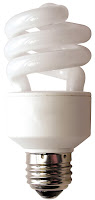 Before this post starts to sound like a lot of CFL bashing, I want to make it clear that I jumped on the CFL bandwagon early. I still remember 8 years ago, shelling out $30 for the 10" long bulbs than took 5 minutes to get to full brightness. And we have a lot of the bulbs in the house.
Why? For starter's they are even more energy efficient. The most efficient LEDs can use 1/2 the energy of CFLs. LED light bulbs also last three times longer than CFLs. CFLs boast on average a lifespan of around 8,000 to 15,000 hours, LEDs are closer to 50,000.
But more importantly they have no mercury. All CFLs contain at least 1mg of mercury and most have 3 to 5 mg. May not sound like a lot but last year there was over 100 tons of mercury put into CFL bulbs in the United States alone. So don't throw them in the trash, otherwise all that mercury ends up in the landfill and ultimately the groundwater. CFLs need to be recycled and you can often return them to the store they were purchased at.
To ensure a fair and balanced blog, I will now point out though that in lots of areas the use of a CFL will still result in a net reduction of mercury emissions. Coal power plants have mercury emissions of varying degrees but on average the use of a incandescent bulb for 8000 hours will cause 6mg of mercury emissions. So if you live in an area where the power is generated by coal, a low mercury CFL will reduce our power consumption and could result in a net emission of only 3 or 4mg.
If all of that wasn't enough this week I also came across the following video: "Dirty Electricity". The CBC report by Geeta Nadkarni was part of the "Be Green" series. The report highlights the fact that CFLs induce pulses of high frequency electromagnetic energy in your home electrical system. The concern is that these Electromagnetic fields (EMFs) are getting linked to a wide range of health problems. I am sure there are experts on both sides of that debate but it provides one more advantage in LEDs favour.
Efficiency, lifespan, no hazardous chemicals, and potential health benefits. Sounds like a clear victory for LEDs over CFLs. So our green kitchen is obviously lit purely by LEDs.... right?
err....
 This is the part where our optimism and ideologies met the harsh realities of dealing with emerging technologies. Just like CFLs were bulky, flickered and slow to turn on a half decade ago, the majority of LED bulbs on the market aren't quite performing quite like they should. LEDs turn on instantly but they vary significantly in terms of light output and efficiency. Light output is measure in terms of Lumens, so when buying bulbs try to compare lumen output not the advertized "Wattage Equivalent". I was very diappointed when looking at LED bulbs to find that many said they were 40W equivalents but produced only 50% or 70% of the lumens. Lots of LED bulbs do not even list their lumen output on the package (not very reassuring).
When we finally found the bulbs that had the efficiency and output we required the price tag for just the bulbs in our track lighting came to $700. A bit more than we had budgeted. As with any new technology, the products will get better and the price will get lower. So we decided on using halogens on a temporary basis with the plan to upgrade to LEDs in a couple years.
Is it the ideal solution? No, but it seemed like the right call for now.
 Before this post starts to sound like a lot of CFL bashing, I want to make it clear that I jumped on the CFL bandwagon early. I still remember 8 years ago, shelling out $30 for the 10" long bulbs than took 5 minutes to get to full brightness. And we have a lot of the bulbs in the house.
CFLs became the poster child of the green consumer revolution and for good reason: they kick traditional incadescents' butt. They use 25% of the energy and last 10 times longer. Less energy consumed and less waste generated. But if you want the best technology for the environment (and maybe even your health) that is (or will be) LEDs.
Why? For starter's they are even more energy efficient. The most efficient LEDs can use 1/2 the energy of CFLs. LED light bulbs also last three times longer than CFLs. CFLs boast on average a lifespan of around 8,000 to 15,000 hours, LEDs are closer to 50,000.
But more importantly they have no mercury. All CFLs contain at least 1mg of mercury and most have 3 to 5 mg. May not sound like a lot but last year there was over 100 tons of mercury put into CFL bulbs in the United States alone. So don't throw them in the trash, otherwise all that mercury ends up in the landfill and ultimately the groundwater. CFLs need to be recycled and you can often return them to the store they were purchased at.
To ensure a fair and balanced blog, I will now point out though that in lots of areas the use of a CFL will still result in a net reduction of mercury emissions. Coal power plants have mercury emissions of varying degrees but on average the use of a incandescent bulb for 8000 hours will cause 6mg of mercury emissions. So if you live in an area where the power is generated by coal, a low mercury CFL will reduce our power consumption and could result in a net emission of only 3 or 4mg.
If all of that wasn't enough this week I also came across the following video: "Dirty Electricity". The CBC report by Geeta Nadkarni was part of the "Be Green" series. The report highlights the fact that CFLs induce pulses of high frequency electromagnetic energy in your home electrical system. The concern is that these Electromagnetic fields (EMFs) are getting linked to a wide range of health problems. I am sure there are experts on both sides of that debate but it provides one more advantage in LEDs favour.
Efficiency, lifespan, no hazardous chemicals, and potential health benefits. Sounds like a clear victory for LEDs over CFLs. So our green kitchen is obviously lit purely by LEDs.... right?
err....
ummm...
..... we did just order LED lights for under the cabinets....
 This is the part where our optimism and ideologies met the harsh realities of dealing with emerging technologies. Just like CFLs were bulky, flickered and slow to turn on a half decade ago, the majority of LED bulbs on the market aren't quite performing quite like they should. LEDs turn on instantly but they vary significantly in terms of light output and efficiency. Light output is measure in terms of Lumens, so when buying bulbs try to compare lumen output not the advertized "Wattage Equivalent". I was very diappointed when looking at LED bulbs to find that many said they were 40W equivalents but produced only 50% or 70% of the lumens. Lots of LED bulbs do not even list their lumen output on the package (not very reassuring).
Is it the ideal solution? No, but it seemed like the right call for now.
Saturday, September 18, 2010
Ahhh, a working kitchen
Often during renovations, I find myself thinking about the 80s movie the "Money Pit". There are little moments in it that capture the essence of renovating to me. In particular this past week, I was remembering the scene where Tom Hanks finally had stairs and Shelley Long got her running water. They were ecstatic over the return of the simple conveniences that we take for granted every day. We can relate.

You will have to forgive the short hiatus in the blog but the reality was between my day job, the renovations and preparing for our new baby (due at the end of the month) there just wasn't time. I will go back and post details on what happened over the last three weeks but where we are today:


17 weeks after we started deconstructing our kitchen and 15 after we lost the sink and the dishwasher... we have a functioning kitchen again. After nearly 4 months of washing dishes in the bathtub the sound of running water in the kitchen was very exciting. Especially as the water was flowing out of the faucet and into the sink (trust me that is not always the case with plumbing projects).
You will have to forgive the short hiatus in the blog but the reality was between my day job, the renovations and preparing for our new baby (due at the end of the month) there just wasn't time. I will go back and post details on what happened over the last three weeks but where we are today:

- Ceiling: vapour barrier, drywall, mudded and tapped and primed (will stipple later on)
- Walls: drywalled, mudded and tapped, primed and painted
- All electrical completed (except for microwave plug) and functional
 |
| I like the organic look of our temporary counters |
- All plumbing completed and functional
- All appliances installed including new dishwasher
- Cabinets 70% installed - rest waiting on the counters
- Counters: using plywood counters temporarily, To be honest the good-one-side FSC plywood with water based Varathane coating (low VOC) is proving to be a very functional (and green) $110 counter top. And I generally like how it looks. Probably some long term durability concerns though. When the permanent counter come in these will work wonderfully in my workshop.
- Flooring: sub-floor repaired and levelled and cork flooring installed
What's left: permanent counters, rest of the cabinets, window trim, baseboards, floor thresholds, heating ducts, hood fan, painting touch ups.
Saturday, August 21, 2010
"Buying Local" also works for home renovations
There has been a growing movement to "Buy Local; Think Global". For most people this applies to what is in their grocery cart. This is a great initiative: supports local farmers, reduces packaging and shipping, fresher fruits and vegetables etc. A lot of that applies to building materials as well. While I do not really worry about the freshness of my vapour barrier, if it had to travel across the country to get to me it has an increased ecological footprint and cost.
When you think that a typical bungalow weighs 350,000 lbs, if all of your material was transported 100km less by truck that would be a fuel savings of approximately 1200L (I like how I mix metric and imperial units... that made the math even more fun) or 3 tonnes of green house gas emissions. Unfortunatey, for a lot of products 100km is a very small fraction of their trip.
Products, especially specialty ones, can travel some long distances. We are looking at cork flooring for the kitchen: a very green product in a lot of ways (will blog about that later). But, cork is harvested in Spain or Portugal. Luckily it is light, the same can not be said for granite. Granite is harvested rock, and the colours and patterns will be determined by the location they were mined. So that perfect colour combination might mean that a 800lb counter top had to travel from Brazil or South Africa or China.
LEED recognizes this. I mentioned before that our cabinets were "Environmentally Preferable Products" (MR 2.2). LEED provides points for products that not only reduce environmental impact or are low emissions but also ones that are locally produced. Their definition of locally produced means it must be extracted, processed and manufactured within 800km or 2400km if transported by rail (yeah!). For each product category you get a 0.5 point for each locally sourced item.
Being in the Montreal area, we lucked out a lot here. There is enough natural resources and a big enough population that we have a lot of options for local production. Doing a quick audit of material sources for the products we are currently using the following qualify as locally produced:
 Vapour barrier
- Acoustical sealant
- Drywall mud
- Drywall
- Rigid insulation
- Floor leveller
- Primer
- Paint
- Roxul (depending on were the Basalt was mined)

To be perfectly honest , I was only aware of the locality of the rigid insulation, paint and drywall at the time of purchase. So in the case we are accidentally awesome. And added bonus for us as well, is that any reclaimed materials from our own Gut/Rehab count as locally sourced. So anything salvaged out of our deconstruction would qualify as locally sourced as well.
I anticipate that we will get the 8 point maximum for Environmentally Preferable Products but I will only show 5 right now on our scorecard to the right because that is where we would be if we stopped construction today.
I anticipate that we will get the 8 point maximum for Environmentally Preferable Products but I will only show 5 right now on our scorecard to the right because that is where we would be if we stopped construction today.
Sunday, August 8, 2010
Approvals!
With the cabinets planning to be installed in the next week ,we are under the gun to have the kitchen ready. Having lost time to the fireplace, the last weeks have been pretty hectic.
Added to the regular workload was two procedural challenges. First, we had a non-structural wall that we were planning on knocking down. The city of Dollard-des-Ormeaux was willing to let us knock down anything that wasn't load bearing, but the oweness was on us to prove it wasn't a structural wall.
Once we had it all stripped down and could show that the 2x3 wall had no headers and was built parallel and between the ceiling joists it was an easy sell. The wall came down the same day.

The second step was LEED EA prereq 2.1: Insulation must be inspected by the green rater prior to the installation of drywall. Because the quality of the insulation and how it is installed is so critical to the overall project, they need to verify that there are not any issues. In particular they focus on ensuring the whole enevlope is sealed and insulated and there aren't any hidden gaps. It is this inspection where the fireplace would have been flagged.
But we passed with flying colours!! So we are on to drywalling.
Subscribe to:
Posts (Atom)